8/7/2026 | 10 Minute Read
Topics:

The conversation around artificial intelligence (AI) has changed rapidly as the technology continues to evolve. A year ago, most IT teams were experimenting with copilots that summarized tickets or generated documentation. Today, AI agents can classify service requests, investigate security alerts, execute remediation workflows, and coordinate work across multiple systems. That shift moves AI from assisting technicians to completing operational work alongside them.
Here are ten practical agentic AI applications that are transforming how managed service providers (MSPs) and IT teams operate today.
Agentic AI use cases at a glance

Ticket triage is one of the most common and time-consuming tasks in IT operations. Service desks often spend significant time reviewing incoming requests, determining priority levels, categorizing issues, and assigning work to the appropriate technician.
Agentic AI automates much of this process. Rather than relying on predefined workflows alone, AI agents evaluate ticket content, historical resolution patterns, user context, device information, and business impact to determine the appropriate priority, routing path, and next action. Agents can categorize tickets, assign priority levels, route requests to the correct queue, and surface relevant context before a technician becomes involved.
Business outcome
Technicians spend less time reviewing and routing incoming requests, allowing them to focus on resolution instead of administration. As ticket volumes grow, AI-assisted triage helps maintain consistent service levels, improves SLA performance, and makes the service desk easier to scale.
Password resets, account unlocks, software access requests, and basic troubleshooting account for a significant portion of daily service desk activity. While straightforward, these requests consume valuable technician time and contribute to growing ticket volumes.
Instead of routing every request to a technician, AI agents can engage with users, gather information, answer questions, and resolve routine issues. Unlike traditional chatbots, AI agents understand context, adapt conversations, and determine the next best action. When escalation is required, they can transfer the request with complete documentation and supporting context.
Business outcome
Routine requests are resolved faster, while technicians spend more time on complex issues that require human expertise. The result is a better end user experience, lower ticket volumes, and the ability to support continued growth without expanding the service desk at the same rate.
Check out our service desk agents ROI calculator to see how AI agents can generate real ROI.
Employee onboarding and offboarding often span identity management, endpoint provisioning, documentation, licensing, and security control. Coordinating those systems manually increases the risk of delays, errors, and inconsistent access management.
Agentic AI can orchestrate these workflows from end to end. When a new employee joins, agents can trigger account creation, assign licenses, provision applications, generate documentation, and verify policy compliance. During offboarding, agents can revoke access, recover assets, update records, and document completed actions automatically. Because these workflows span identity systems, service management tools, endpoint platforms, and security controls, onboarding and offboarding represent one of the strongest examples of agentic AI in action.
Business outcome
Employees receive the access and resources they need sooner, while departing users are removed from systems more consistently. Standardizing these workflows improves security, reduces administrative effort, and creates a more predictable onboarding experience.
Many IT processes involve multiple systems, approvals, and decision points. Traditional automation can struggle with these workflows because it relies on predefined rules and limited context, often requiring manual intervention when unexpected scenarios arise.
AI agents coordinate work across multiple systems, allowing complex workflows to continue without constant technician involvement. Multiple AI agents can coordinate actions across service management, endpoint management, cybersecurity, and documentation systems to automate end-to-end workflows.
Business outcome
Instead of automating isolated tasks, organizations can automate complete operational workflows. Fewer manual handoffs improve consistency, reduce delays between teams and systems, and allow technicians to manage increasingly complex environments more efficiently.
Managing endpoint health across hundreds or thousands of devices can place significant demands on IT teams. Monitoring performance, identifying issues, and maintaining device reliability often requires constant attention.
AI agents continuously monitor device health, identify anomalies, and execute approved remediation workflows. Agents can proactively address common issues before they affect users, helping reduce support requests and improve device performance.
Business outcome
Potential issues are identified before they disrupt users, improving endpoint reliability across the environment. With less time spent reacting to routine device problems, IT teams can support more endpoints while maintaining service quality.
Many IT issues follow familiar patterns. Services stop unexpectedly, endpoint agents become unresponsive, disk space fills up, or configuration changes introduce recurring problems. Even though the fixes are well understood, technicians often spend valuable time resolving the same issues repeatedly.
AI agents can detect these conditions, execute approved remediation workflows, validate the outcome, and document every action taken. Common examples include restarting SQL services, repairing WMI repositories, clearing temporary files, restarting backup agents, or reinstalling endpoint management agents. Because agents can evaluate device health and previous outcomes before taking action, remediation becomes more adaptive than traditional rule-based automation.
Business outcome
Recurring issues are resolved more quickly and require less technician involvement. That means fewer repetitive tickets, more consistent service delivery, and additional capacity for project work, customer engagement, and higher-value technical initiatives.
Most organizations don't realize how much time they spend responding to preventable issues until they begin tracking recurring failures. Instead of waiting for users to report problems, AI agents analyze performance data, endpoint telemetry, and historical trends to identify early warning signs and recommend or initiate approved corrective actions before users experience an outage.
Business outcome
Addressing issues before they become outages reduces downtime, improves system reliability, and extends the useful life of IT assets. Over time, IT teams spend less time responding to emergencies and more time on planned improvements that strengthen the environment.
Modern IT environments generate large volumes of alerts across infrastructure, endpoints, applications, and security systems. Many of these alerts are duplicates, false positives, or low-priority events that create unnecessary noise for IT and security teams.
AI agents correlate events across systems, identify relationships between alerts, and filter activity that does not require action. Rather than presenting technicians with hundreds of disconnected notifications, AI agents consolidate related events into actionable incidents and provide the context needed for faster decision-making.
Business outcome
IT teams spend less time sorting through duplicate or low-priority alerts and more time investigating meaningful incidents. Better signal-to-noise ratios improve response.
Maintaining compliance with industry regulations and internal policies often requires continuous monitoring, evidence collection, and extensive documentation. Manual compliance processes can be time-consuming and difficult to scale.
Agentic AI can continuously assess systems for compliance gaps, monitor policy adherence, collect supporting evidence, and generate audit-ready reports. Agents can also identify violations, recommend corrective actions, and document remediation efforts automatically, creating a continuously updated record of compliance status and remediation activity.
Business outcome
Compliance activities become part of day-to-day operations instead of a scramble before an audit. Continuous monitoring and automated evidence collection reduce manual effort, improve audit readiness, and provide clearer visibility into the organization's compliance posture.
Security operations teams face growing pressure as threat volumes increase and attack techniques become more sophisticated. Analysts often spend significant time reviewing alerts, gathering evidence, and investigating potential threats before determining whether action is required.
AI agents act as a force multiplier to reduce the amount of manual investigation required by gathering evidence, correlating alerts, and recommending next steps before an analyst begins their review. Agents can analyze alerts, gather supporting evidence, correlate threat intelligence, and recommend response actions. As organizations mature, agents can also execute approved containment and remediation workflows while maintaining human oversight for high-risk decisions.
Business outcome
Security analysts receive richer context before beginning an investigation, allowing them to make decisions more quickly and consistently. Faster investigations, reduced dwell time, and improved response workflows help security teams scale their operations without proportional increases in staffing.
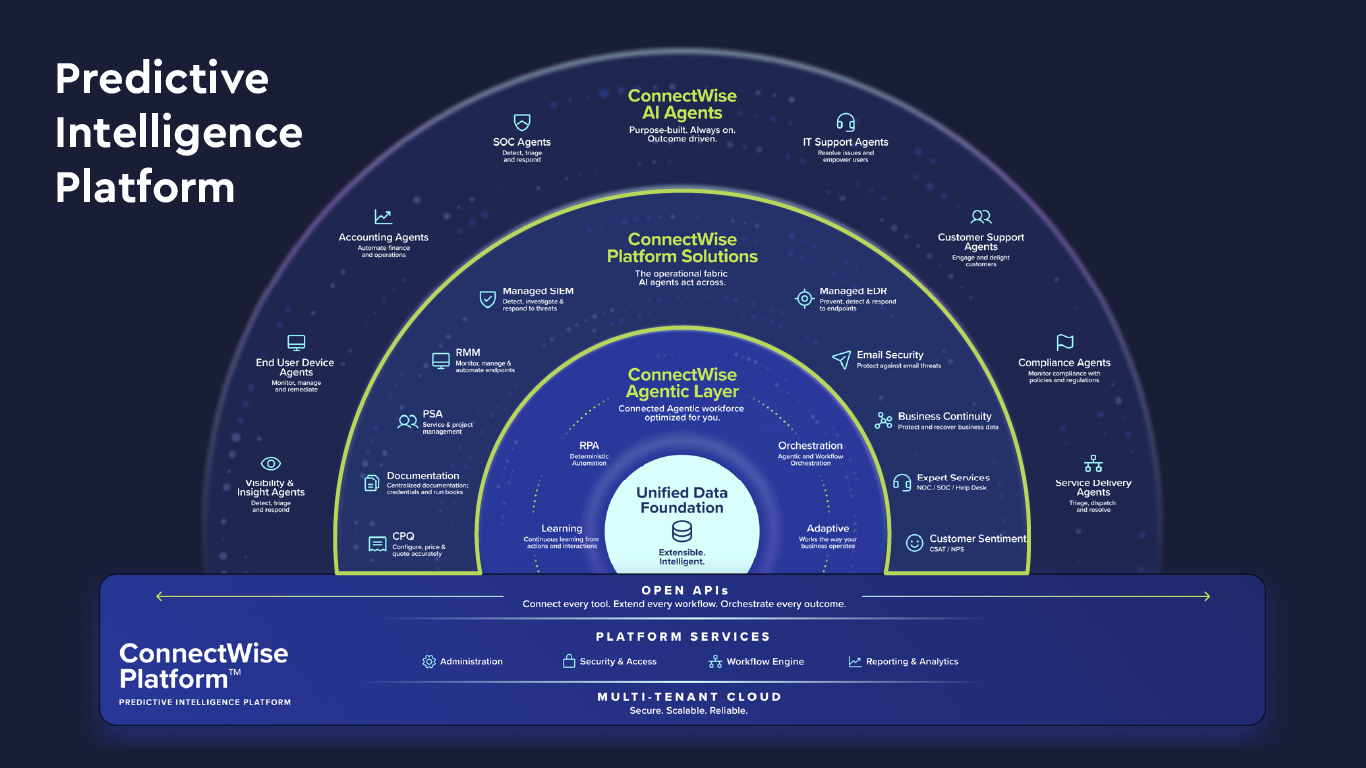
AI agents deliver the most value when they have access to trusted operational data and the ability to execute work across connected systems. A unified platform provides the context needed to automate complete workflows instead of isolated tasks, allowing MSPs and IT teams to expand what they can accomplish without continually adding headcount.
Explore how ConnectWise AI Agents help MSPs and IT departments automate service delivery, IT operations, cybersecurity, customer support, and business workflows from a unified data foundation.
Share:


AIOps stands for artificial intelligence for IT operations. It combines artificial intelligence, machine learning, and automation to improve the monitoring, analysis, and management of IT systems. AIOps platforms collect data from across networks, applications, and infrastructure to detect issues, correlate alerts, and automate responses faster and more accurately than manual methods.
Traditional automation executes predefined tasks or scripts. AIOps adds intelligence by analyzing data, identifying anomalies, predicting potential failures, and taking adaptive action. Instead of reacting after an incident occurs, AIOps anticipates problems and prevents them, helping IT teams move from reactive operations to proactive, predictive service delivery.
AIOps improves continuity by minimizing downtime and accelerating recovery. Through predictive analytics and automation, it identifies risks early, triggers failovers automatically, and keeps systems available during unexpected events. This proactive approach strengthens resilience and helps organizations maintain performance even under pressure.
Begin by identifying high-value, repetitive tasks that cause alert fatigue or slow response times. Ensure your monitoring tools feed consistent data into a centralized system. Then, introduce automation in small, measurable pilots, such as automated incident correlation or self-healing workflows. As teams gain confidence, expand AIOps adoption across broader processes and integrate it with your existing IT management tools.
AIOps is the foundation for the next significant evolution: autonomous service. In this model, AI-driven systems work alongside humans to deliver IT services at scale, automatically resolving issues and continuously optimizing operations. To learn how to prepare for this shift, explore The Age of Autonomous Service: How IT Providers Can Thrive in an AI-First World.





