5/7/2024 | 8 Minute Read
Topics:

5/7/2024 | 8 Minute Read
Topics:
A managed service provider platform, or MSP platform, is a software solution designed to help MSPs efficiently centralize and optimize IT service delivery. It’s a platform purpose-built for the specific needs of MSPs, combining solutions and capabilities in one place to help them efficiently and proactively manage customers’ IT infrastructure and systems.
In essence, it’s a single solution where MSPs get more benefits than several integrated solutions, including:
With all of these capabilities in a true platform solution, MSPs like you have a massive opportunity to deliver high-quality IT services, enhance client satisfaction, and effectively scale your operations. It paves the way for more business growth while driving down costs. Most importantly, it’s an innovative solution that can improve service delivery and customer trust while reducing customer turnover and increasing cross-sell and referral opportunities.
Solutions for managed service providers (MSPs) have consistently evolved to be bigger and better over the past few decades, helping the industry and individual businesses experience continual growth. There are at least three major advancements in MSP solutions that are leading us to the next game-changing solution for MSPs.
Next, we turned to point solution integrations, and the industry got very good at making point solutions work together to create much more automation, efficiencies, and growth opportunities. However, maintaining integrations between separate products can be time-consuming and frustrating. This often includes queueing issues, duplicate endpoints, and information errors when dealing with disconnected products. Also, managing multiple user experiences and working with different support teams can add to the complexity and cost of maintaining separate products. Unfortunately, these problems cannot be simply solved with single sign-on and a centralized portal.
So what’s next? A purpose-built MSP platform.
A true MSP platform doesn’t just solve integration frustrations; it sets the stage for transforming automation to hyperautomation. Don’t write it off as a buzzword—hyperautomation is a true game-changer for MSPs!
Hyperautomation is an advanced end-to-end approach that integrates various automation technologies to automate complex business processes and deliver digital transformation at speed and scale. It promises to automate not just tasks but entire businesses end-to-end. It leverages several technologies, including robotic process automation (RPA), workflow orchestration, generative artificial intelligence (AI), machine learning (ML) to automate complex business processes and deliver digital transformation at speed and scale.
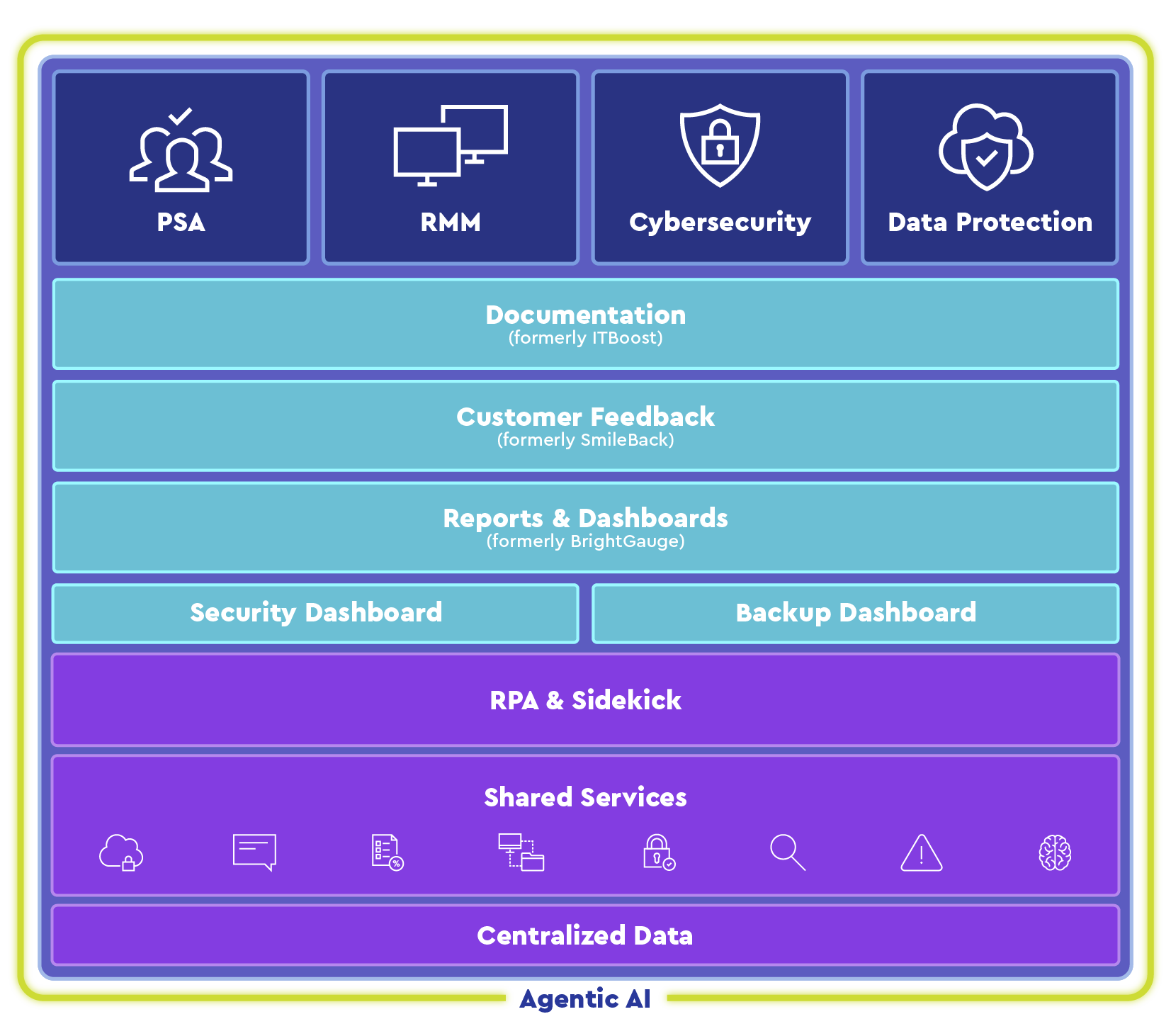
In today’s competitive market, MSPs face the challenge of choosing the right solutions to streamline their operations. Many MSPs have realized that buying and maintaining separate point solutions can lead to additional costs and inefficiencies. These costs can quickly add up and hinder the growth and profitability of an MSP. The extra costs of managing integrated yet disparate systems impact MSP owners and their technicians. The time spent managing these solutions could be used for more productive, revenue-driving tasks.
A true MSP platform eliminates the hidden and unnecessary costs of managing integrated yet disparate systems because it is purpose-built for the MSP space, which creates a modern user experience, centralizes disparate datasets, and creates automation that can span their entire customer ecosystem.
A multi-tenant, multi-tier platform-as-a-service purpose-built for MSPs leverages common services and a centralized data store, ensuring seamless integration and eliminating the pain points associated with maintaining multiple products. This centralized approach has hyperautomation-driving technology built right into its architectural core, using robotic process automation (RPA) and generative AI to enable a new work paradigm for MSPs.
“Platform” can mean different things to different companies. Some may call integrated point solutions a “platform,” but a true platform has several solutions built into one architecture with no integration maintenance falling to MSPs.
Ensure that the platform meets industry-standard security protocols and compliance requirements. Look for features such as data encryption, access controls, audit logs, and compliance reporting to protect your clients’ sensitive information.
Research the vendor’s reputation in the market and their track record of customer satisfaction. Read reviews, seek recommendations, and evaluate their customer support services.
Assess the vendor’s commitment to innovation and staying ahead of industry trends. Look for evidence of ongoing product development, research, and investment in emerging technologies. This will mean that the platform will continue to evolve and meet the changing needs of your MSP business.
Evaluate the vendor’s partnerships and ecosystem. Look for the platform’s ability to extend with other tools and systems that you use in your operations. Seamless extensibility with other third-party applications in a single data layer can streamline your workflows and improve efficiency.
Evaluate the platform’s ability to scale as your business grows. Consider factors such as the number of devices or endpoints it can support, the capacity to handle increased workloads, and the ability to accommodate additional clients.
Assess whether the vendor has an active user community or forum where MSPs can collaborate, share best practices, and seek peer assistance. Engaging with a community of like-minded professionals can provide valuable insights and support.
Consider the vendor’s stability and longevity in the market. Look for a vendor with a proven track record and a solid financial standing, which helps ensure their investment in long-term platform support and enhancements.
A true MSP platform creates a unified data layer with a centralized and integrated repository that stores and manages all relevant data collected from sources within the platform. This data layer plays a crucial role in the effectiveness and efficiency of an MSP’s operations. Here are some key reasons why a unified data layer is important in an MSP platform:
Consolidate data from different sources, such as monitoring tools, ticketing systems, asset management, and cybersecurity solutions. This consolidation eliminates data silos and provides a holistic view of the client’s IT environment. It enables MSPs to comprehensively understand all their clients’ infrastructure, applications, security posture, and performance.
Access real-time and historical data in a single location and make informed decisions based on accurate and up-to-date information. They can analyze trends, identify patterns, and gain insights into their clients’ IT operations. This data-driven decision-making helps MSPs optimize resource allocation, prioritize tasks, and proactively address issues.
Experience the full power of AI with a centralized data layer. Streamline workflows, automate processes, and reduce manual effort with tools and systems integrated within the platform. For example, tickets can be automatically created based on monitoring alerts or automatic deployment of patches based on vulnerability scan results. This automation improves operational efficiency, reduces human error, and allows MSPs to deliver services more effectively.
Monitor and manage client environments proactively to identify potential issues, predict system failures, and take preventive actions before they impact the client’s operations. This proactive approach helps minimize downtime, improve system performance, and enhance client satisfaction.
Generate comprehensive reports and perform in-depth analytics to create customized reports for clients that showcase key metrics, performance trends, and cybersecurity insights. These reports help demonstrate the value of MSP services, track service level agreements (SLAs), and provide transparency to clients.
Overall, a unified data layer in an MSP platform is currently the most powerful tool for efficient data management, informed decision-making, streamlined workflows, proactive monitoring, and effective reporting. It empowers MSPs to deliver high-quality services, optimize their operations, and provide value-added insights to their clients.
As we move forward, businesses are adapting to a fluid digital infrastructure, with MSP platforms increasingly managing remote or hybrid cloud systems and dispersed workforces. Looking into the future, there’s a strong anticipation for MSPs to adopt generative AI tools, such as ChatGPT, to streamline tasks, including RMM script generation and incident response formulation.
Integration of generative AI in MSP platforms can significantly improve operations by offering advanced data analysis, which supports better decision-making and the personalization of services. As such, the future promises a continuation of MSP platform evolution, integrating advanced technologies to meet the growing and changing needs of businesses in the digital age.
ConnectWise has been innovating in the IT space for over 40 years to become the leading software provider for MSPs. With our revolutionary spirit, we’ve built The ConnectWise Platform, the only modern, scalable, and secure cloud-based platform purpose-built for MSPs. It leverages centralized data and common services including ticketing, contacts, and alerting, further supported by a generative AI engine and an orchestration layer to deliver hyperautomation and unparalleled productivity for MSPs through a single user interface.
The ConnectWise Platform offers MSPs a comprehensive platform that eliminates the extra costs associated with disconnected products. By providing a common user experience, leveraging common services and a centralized data store, and incorporating hyperautomation and expert services, The ConnectWise Platform enables MSPs to achieve unparalleled productivity and profitability. Take the first step towards cost savings and revenue growth by exploring the potential of The ConnectWise Platform today.
Share: