4/24/2026 | 5 Minute Read
Topics:

As your business expands, initial growth often comes from ad hoc referrals and positive word-of-mouth stemming from your quality work. While this organic growth is gratifying, relying solely on an “anything for a buck” approach can lead to chaos and inefficiencies that hinder further expansion. The key to sustained growth lies in transitioning from one-off projects to offering repeatable services structured around monthly recurring revenue (MRR). Highly mature companies have recognized the importance of building delivery systems around these predictable services.
Setting revenue goals for the year is a common practice, but managing to these targets effectively is crucial for success. Understanding the significance of achieving these goals early in the year can significantly impact your overall performance. Conversely, falling short of these targets early on can make it challenging to catch up later. This dilemma is where the “Rule of 78,” a fundamental concept for monthly recurring businesses, comes into play.
The rule of 78 is a simple tool that will break a yearly MRR goal down into a monthly quota. If you hit your quota each month, you will ultimately achieve your overall MRR goal. As you improve your budgeting and forecasting maturity, the rule of 78 is an invaluable way of setting the standard to know if your current progress will get you to your desired MRR goal.
To apply the rule of 78, simply take a yearly MRR goal and divide it by 78. The result will be what you need to sell each month.
As an example, let’s say you want to grow your MRR by $100,000 over the course of a year. To understand how much you would need to sell every month, you simply take that number and divide it by 78. In this case, it would be $100,000/78 = $1283. If you sell $1283 of MRR in January, again in February, and so on through December, you will have added $100,074 in MRR to your revenue for the year.
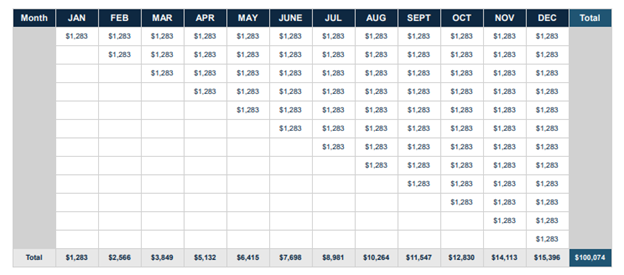
For the $1283 you sell in January, you will invoice that amount 12 times throughout the year—once each month. For the $1283 you sell in February, you will invoice that amount 11 times—once each month starting in February. If you add 12 + 11 + 10 and so on, all the way down to one, it adds up to 78. You will get 78 payments of $1283 over the course of the year if you sell that amount each month. If you miss January and don’t make a sale, you are now faced with needing to sell $1515 each month starting in February. We get that number by taking our goal ($100,000) and dividing it by 66 (which is 78 minus the 12 payments we won’t receive because we didn’t sell anything in January). You can use this math to determine goals for how many new seats you need to sell each month to reach your goal. If you charge $125/month/seat and you need to generate the $1283 to hit your $100,000 target, you know you need about 10 new seats per month. If that doesn’t seem realistic, you need to lower your targets or find a way to crank up the lead gen and sales activity to reach your goals.
The great news is, if you do reach your goals, that is a healthy growth in run-rate business, and you’ll start next year with $15,396 more revenue coming in each month than you started with this year. That’s $184,752 over 12 months. Your $100,00 goal for this year turns into $184,752 in contracted business next year that you don’t have to re-sell! With that in mind, the power of focusing on MRR and learning to set aggressive but realistic goals to grow your business becomes clear.
1. Increased profitability through compounding revenue:
The rule of 78 emphasizes the compounding effect of recurring revenue over time. By focusing on building a strong base of recurring revenue streams, managed service providers (MSPs) can experience exponential growth in profitability. As revenue compounds, the financial health of the business improves, providing a stable foundation for long-term success.
2. Highlights the importance of customer lifetime value and retention:
The rule of 78 contributes to an MSP’s overall customer lifetime value management by highlighting the importance of nurturing long-term relationships with clients. Providing consistent value and quality services can lead to increased customer loyalty and retention. Every client that you lose means you must adjust your incoming MRR to hit your goals. As part of an overall MRR tracking process, you will quickly realize the importance of retention and learning how to forecast both MRR additions as well as attrition to ensure you hit your yearly targets.
3. Improved forecasting and financial planning capabilities:
Leveraging the rule of 78 enables MSPs to gain better insights into their revenue projections and financial performance. With a clear understanding of recurring revenue streams and growth trends, MSPs can make informed decisions regarding resource allocation, investments, and strategic planning. This leads to more accurate forecasting and improved financial stability.
1. Monitoring key performance indicators (KPIs) related to recurring revenue:
Tracking KPIs such as customer churn rate, average revenue per user, and customer lifetime value is essential for evaluating the performance of recurring revenue streams. By monitoring these metrics regularly, MSPs can identify areas for improvement and optimize their revenue-generating activities.
2. Continuous optimization of pricing strategies based on customer value:
Regularly reviewing and adjusting pricing strategies based on customer feedback and market dynamics can help MSPs stay competitive and maximize revenue potential. By understanding the value proposition of their services to clients, MSPs can price their offerings effectively to capture value and drive growth.
3. Investing in customer success and relationship management:
Prioritizing customer success and building strong relationships with clients are key to driving long-term revenue growth. These account management functions will lead to a more natural pipeline to help you forecast and hit your monthly quotas.
Embracing the rule of 78 and adopting proactive growth strategies will enable MSPs to differentiate themselves in the market, enhance customer relationships, and reach their growth goals effectively.
Here is your call to action to get started:
Learning these concepts is a big driver to moving past “muscle and feel” to start managing to what good looks like in your business. And that’s a much better place to be.
Want to learn more about how you can move your business past a muscle and feel approach? Consider joining an IT Nation Evolve peer group >>
Share: